Menu toggle

Cayman 718 GPF Failure

Hi Tony, 911Hillclimber,

Yes your absolutely right, the article was well written and covered lots of facts about this issue, but unfortunatly its been forgotten about.

Hopefully the Porsche Post would like to do a follow-up account of where we are now, and what progress we have made, we will need a few more pages.

We hit 200 thousand views on this subject this morning, 2 thousand this week so far, which is brilliant, it just shows the interest out there regarding our push to get this fault sorted out.

Its unbelievable that in this current climate, the Dealers and Porsche are still wanting to fit this expensive GPF part, when they clearly know it doesn't fix this Ash % software calculation issue.

Dealers around the country have customers asking them why has the ash % returned on their new modified GPF filter's, and are still waiting for an answers.

We are concentrating on the UK market at the moment, its keeping us busy, but to us its an issue that can not go away, like the bore scoring problem. Because this fault is becoming a major miss diagnosis problem in its own right.

You only have to read the internal memo that covers this subject to understand why we are bringing it to the attention of people who are affected by it.

We shouldn't be worried about this light coming on when these cars are going in for an mot.

We shouldn't be in position where we are thinking about selling these cars because the cost of this repair, makes no sense at all, and its not needed.

We just need the Dealers to carry out a back pressure check on these cars when the code P242F presents itself.

Then is over to Porsche Technical to find a solution that fixes these cars properaly.

We are desperately trying to fix this issue ourselves, with help from our owners and drivers, we have got this far because of their help, and its always been appreciated, and will continue to be.

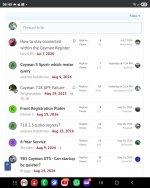
Enclose below is our club page showing are views.

We push on

Dave
 

Attachments

  • Screenshot_20260827_094124_Gallery.jpg
    Screenshot_20260827_094124_Gallery.jpg
    638.7 KB · Views: 5
Hi Guys & Girls

Following on from my last post concerning the functionality of the differential pressure sensors on our cars.

Its always been the case that when the fault code P242F appears on our dashboards, and are cars are plugged into a diagnostic tester we always find the following information.

No soot present, the measured ash is at 100% and the differential pressure sensor readings is usually less than 10 hPa.

And no reports that performance or fuel economy are present, in fact the cars are running fine, before the light comes on, and while its on.

We have said for years now that these filters are not blocked with Ash, and we have proved that there is no backpressure present when the light comes on and the car is being checked.

We have checked 3 cars for back pressure, and we didnt find any.

We have checked a Cayman this week, and carried out a differential pressure sensor check along with a back pressure check.

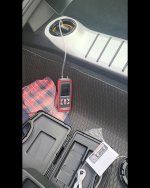
To do this, we connected a manometer into the GPF supply pipe to the sensor, then we connected the car to a diagnostic tester.

We got the engine warm and checked the differential pressure sensor readings on the manometer and the diagnostic testers read out.

You will see from the photograph that our manometer on the left hand side is reading 8.4 hPa and if you look at the testers screen you can clearly see the ash level K231 at 100%.

If you look below at the K251 current differential sensor measured value, you can see its 5.31 hPa, this is the differential pressure sensor reading.

So it's showing two differential pressure sensor measurements with the engine running at idle that do not support a blocked GPF filter.

These pressures converted to PSI are as follows

8.4 hPa = 0.1218316997 PSI
5.32 hPa = 0.0770150387 PSI

So a direct exhaust pressure taken, and a diagnostic testers reading, a conclusive test you will agree.

So yet again, we find no pressure, what we did find on this car was that the cars differential pressure sensor was the original one fitted at the factory and it was showing pressure even when the engine wasn't running, with the ignition on.

These sensors should self zero, and if they don't, it affects the pressure data going back to the algorithm.

When I contacted Stuttgart I wanted to ask them why a simple back pressure test, like the one we have done on this car, and the others wasn't included in the checks on the internal memo.

They passed me on to Porsche GB, they gave me a case number and asked me to contact them if I had anymore information.

Durring that time I tried to contact Porsche Technical several times, and unfortunately, I became a nuisance.

This resulted in me being told I had to stop trying to contact them, which I did.

I was only trying to ask this question

Why wasn't this back pressure check carried out as part of the diagnostic checks on these GPF filters, thats all.

Because if they did, they would find what we have found, no back pressure present.

And if they questioned the low pressure reading from the sensor, and did what we have done to this car, they wouldn't have recommended fitting a new modified GPF filter.

It seems inconceivable that they would ignore these basic diagnostic steps.

We will carry on with our back pressure checks and hopefully they will start to do them themselves and stop this miss diagnosis madness.

Dave
 

Attachments

  • 20260829_194921.jpg
    20260829_194921.jpg
    7 MB · Views: 11
Sorry for the dark picture it was taken in the car last night very late in the evening.

I had to black out the cars details, and re photo the photo sent to me.

But you can just make out the shape of the manometer on the left showing the 8.4 reading along with the time 22: 49: 11, very late.

Dave
 
Morning Dave,

As you know, Porsche agreed to replace my GPF, but to the best of my knowledge, the differential pressure sensor wasn’t changed after the memo checks were completed.

After just 30 miles, the car was showing 3.14% oil/ash fill. I’ve since carried out a diagnostic check on the differential pressure sensor myself, and I’m getting the same results even with a brand-new GPF fitted. With the ignition on and the engine off, the differential pressure sensor is reading 2.65 hPa and never zeroes.

The car is going back to the OPC with my readouts, along with the information you previously shared regarding the sensor version you quoted.

I’ll also be requesting the diagnostic results for the sensor, including confirmation of exactly which sensor is fitted and, specifically, confirmation that it is not the original suspect sensor.

Thanks again for your help.
Tony
 
Morning Tony

Thanks for the information on the sensor, what you have found is typical of what we have been seeing for years.

For some reason these sensors are being ignored, and yet their function is critical to the information the algorithm needs.

Has you have found out, our cars do not have the adaptation function to reset the sensor or the GPF after replacement which is absolutely ridiculous.

It will be interesting to see what the Dealer thinks of your findings, you seem to know alot more than them about your car.

Again the memo tells them to check the sensor functionality, they obviously couldn't be bothered, But never mind they just fit a very expensive GPF on your car, that wasn't required, and Porsche paid for the their miss diagnosis.

Like all the other ones.

Dave
 
Hi Tony

A bit more differential pressure sensor information to back up our investigations regarding the checking of this very important sensor.

When these sensors fault, they stop showing a zero reading, when the ignition is on, engine off.

All these photos were taken from the same car, this car came into the workshop with the warning light on with DTC code P242F oil ash load measured at 100% K231.

We are looking at the differential pressure current value sensor reading K251.

The first photo shows a reading taken with ignition on, engine off. 13.43 hPa (this should be zero)

The second photo shows the idle reading of 22.22 hPa, ( this is far to high)

The third photo shows the reading of the new sensor fitted with ignition on 0.50 hPa.

The fourth photo shows the new sensor reading at idle 9.29 hPa

And the fifth photo shows the sensor reading after a regeneration was carried out to clear the fault code P242F, 0.33 hPa.

You will see the ash measured reading K231 is now at 0.00%.

The sixth photo shows two sensors, the old sensor is top sensor you can see the age of this sensor VW AG 38/18 TN3, 38th week in 2018, the original sensor fitted at the factory.

It will be interesting to see how old you sensor is

Dave
 

Attachments

  • Screenshot_20260831_152627_WhatsApp.jpg
    Screenshot_20260831_152627_WhatsApp.jpg
    1.2 MB · Views: 12
  • Screenshot_20260831_152650_WhatsApp.jpg
    Screenshot_20260831_152650_WhatsApp.jpg
    1.2 MB · Views: 7
  • Screenshot_20260831_152736_WhatsApp.jpg
    Screenshot_20260831_152736_WhatsApp.jpg
    1.3 MB · Views: 6
  • Screenshot_20260831_152756_WhatsApp.jpg
    Screenshot_20260831_152756_WhatsApp.jpg
    1.2 MB · Views: 6
  • Screenshot_20260831_152810_WhatsApp.jpg
    Screenshot_20260831_152810_WhatsApp.jpg
    1.3 MB · Views: 12
  • Screenshot_20260831_154440_WhatsApp.jpg
    Screenshot_20260831_154440_WhatsApp.jpg
    892.6 KB · Views: 12
Morning all,

Look what our friends from the 718 Forum sent us yesterday, just shows the interest on this fault on our cars is attracting.

Some more positive news we got this morning, our 718 Boxster that had the adaptation done on the ash load last week as done over 500 miles with a zero ash reading.

At the same time we replaced the faulty differential pressure sensor, which was the original sensor.

After this sensor was replaced all the readings came back in line, and hopefully will continue.

We will keep you informed on the progress of this car as we go along.

Bearing in mind our cars do not have the adaptation of the GPF ash load in PWIS at the moment.

Dave
 

Attachments

  • Screenshot_20260902_105834_Gallery.jpg
    Screenshot_20260902_105834_Gallery.jpg
    796.3 KB · Views: 12
Hi Guys & Girls

Continuing on with our differential pressure sensor theory that our sensors are sending inaccurate information to the algorithm that is creating this ash accumulation percentage thats not real.

Ive managed to find a,

Standard 0-100 hPa Differential Pressure
Transfer Chart.

It shows the Exhaust Pressure in hPA versus Electrical Signal Output in Voltage.

When we see the GPF data on a car that has the GPF P242F code present oil ash load measured at a very high level, 100%.

We never see a differential pressure sensor reading high enough to support the Ash % recorded.

This Chart shows you the sensor readings in hPa and voltages and the Filter Status Interpretation.

And what a pressure in hPa would be required to substantiate a blocked GPF filter.

We certainly have never seen a GPF filter with anything near 60 to 100hPa recorded.

This is what you would expect if the GPF filter was indeed blocked.

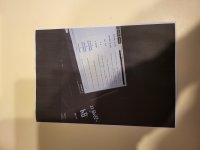
Also enclose a copy of a GPF report showing the oil ash load measured reading at 100%, and the differential pressure sensor reading at 4.81 hPa.

How can our Dealers and Porsche still insist that these GPF filters are blocked with ash and need replacing.

Dave
 

Attachments

  • Screenshot_20260902_192757_Google.jpg
    Screenshot_20260902_192757_Google.jpg
    467.8 KB · Views: 5
  • 20260902_200320.jpg
    20260902_200320.jpg
    7.8 MB · Views: 5

Posts made and opinions expressed are those of the individual forum members

Use of the Forum is subject to the Terms and Conditions

Disclaimer

The opinions expressed on this site are not necessarily those of the Club, who shall have no liability in respect of them or the accuracy of the content. The Club assumes no responsibility for any effects arising from errors or omissions.

Porsche Club Great Britain gives no warranties, guarantees or assurances and makes no representations or recommendations regarding any goods or services advertised on this site. It is the responsibility of visitors to satisfy themselves that goods and/or services supplied by any advertiser are bona fide and in no instance can the Porsche Club Great Britain be held responsible.

When responding to advertisements please ensure that you satisfy yourself of any applicable call charges on numbers not prefixed by usual "landline" STD Codes. Information can be obtained from the operator or the white pages. Before giving out ANY information regarding cars, or any other items for sale, please satisfy yourself that any potential purchaser is bona fide.

Directors of the Board of Porsche Club GB, Club Office Staff, Register Secretaries and Regional Organisers are often requested by Club members to provide information on matters connected with their cars and other matters referred to in the Club Rules. Such information, advice and assistance provided by such persons is given in good faith and is based on the personal experience and knowledge of the individual concerned.

Neither Porsche Club GB, nor any of the aforementioned, shall be under any liability in respect of any such information, advice or assistance given to members. Members are advised to consult qualified specialists for information, advice and assistance on matters connected with their cars at all times.

Back
Top