Menu toggle

Cayman 718 GPF Failure

Dave,

Interesting to note that in that list: “The fix involves a software update.”

Your 718 analysis to date indicates that a software issue is the most likely source of the GPF problem on these cars, so if an update was possible on the listed cars one has to question why not the 718?🤔

Jeff
 
Hi Jeff

Without prejudice

Yes thats another question we will be asking,

My understanding is, that any software or work carried out on a vehicles emission system that causes issues in multiple vehicles, same model, may have to be reported the the authorities who signed off the original emission system.

So the question we will be asking is in 2019, were the authorities aware that a modified filter had been made, to fix our high ash load % issue, reference the Porsche internal memo.

If they were aware, then surely they would need to know that this modification thats been carried out on 13 of our cars, hasn't worked.

The light has gone out, but the ASH % thats come back on all our cars makes no sense at all.

We have to remember all these parts fitted, GPFs, Turbos, AOS, DME, 2 engine strip downs, and even a brand new engine have not corrected this problem.

To say that this Ash value coming back is ok, is absolute nonsense.

If you plugged a PWIS tester into a new 718 in the show room, you should find a zero oil ash reading.

This is because the new car has a new GPF, our cars have had new GPFs fitted, and yet the oil ash reading is back at an unexplained high level.

This fault has nothing to do with the GPF filter, it never had, the evidence we have, speaks for itself

If Porsche Technical could send out to their Dealers, information on why this oil ash % return is acceptable, and then it could be sent out to our owners, this would help.

I know Iam repeating myself again, but we have seen on the 4.0 cars recently between 4 to 5 years old, they are not showing more than 10% oil ash levels.

Another question we need an answer on is, why these cars are so different.

Dave
 
Hi Guys & Girls

Without prejudice

Had some bad news this evening one of our members down south with a 2023 718 Cayman with very few miles had his oil ash % level checked for the 3rd time this year.
Unfortunately its gone up 3 times to over 50 % now.
While he was at the Dealer he asked them to check if his vehicle has the adaptation capability to adapt the differential pressure sensor and GPF.

The Dealer checked and confirmed his car didn't have this function.

He told the Service Manager that he was very worried about this ash level, and the Service Manager told him to blast the car up the road which would reduce the ash.

And if he is worried to come back next year and they would carry out another regeneration.

Our owner has been doing his deacceleration runs when road conditions allowed, durring this year.

He is now thinking of selling the car.

Ive done some research on Ash loading and found several studies on gasoline vehicles with more than 160,000 km have shown that 0.14 to 0.25 mg/km of ash is generated and stored in the GPF filter over that period, which is 40.00 grams of Ash.

So in miles, if we use the same figure, 0.25 mg, convert the 160,000 km to miles we get 99,400 miles x 0.25 mg we get around 25 grams of Ash.

I asked Google Whether 25 grams of GPF ash (Gasoline Particulate Filter ash) is alot of weight.

This is what came back.

In typical automotive contexts, 25 grams of GPF (Gasoline Particulate Filter) ash is considered a very small, negligible amount of weight. GPF ash accumulates over the lifetime of the vehicle, and modern filters are designed to handle much larger quantities.

To provide context:
In general terms: 25 grams is a light weight, roughly equivalent to four tablespoons of gelatin, or five U.S. nickels.

In GPF/DPF terms: A DPF ash mass of around 39 grams is considered on the high side but not yet problematic, while issues usually arise at 45-50 grams. Given that GPFs are specifically designed to accumulate less ash than DPFs and the accumulation process is very slow (over years and tens of thousands of miles), 25 grams represents only a fraction of the filter's capacity.
Therefore, 25 grams of GPF ash is a minimal amount and not a cause for concern regarding filter performance or potential clogging.

Hopefully if my maths are correct, then this again demonstrates that these filters are not blocked with ASH, so why are the Dealers and Porsche telling us they are.

Again they could check the weight of one of our supposedly blocked filters against a new filter.

Dave
 
They would need some good scales for that I think. Not sure what the DPF actually weights, but an old stand-alone cat is several Kgs.

Saying an 'Italian Service' is needed seems a bit crude in this day and age, good for a Morris Minor, but a late model Porsche?
The owner was fobbed-off surely?
The dealer has no real solution because the Factory do not have one either.

Selling the car is understandable while looking at a lot of grief and a £9,000 bill.

Is this a UK spec car issue or is it global?
 
Hi 911Hillclimber

Without prejudice

Thanks for your feedback, regarding your question, is this a UK spec car issue.

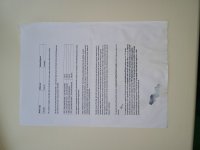
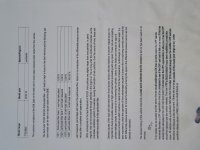
The Porsche internal memo explaining what to do if a customer complains of the EML light coming on with DTC P242F- particulate filter ash load to high.

Top right hand side heading Markets/Regions
Says worldwide.

At the bottom of the memo, it says
If there are any issues outside of this model year range or any further questions please submit a PRMS ticket.

Has I said yesterday we have on file a 2023 Cayman with ASH readings of over 50%, hopefully the Dealer has contacted them and raised a ticket.

Dave
 

Attachments

  • 20251112_095509.jpg
    20251112_095509.jpg
    3.2 MB · Views: 6
Sorry Dave, but your maths is a little wayward. You seem to be multiplying the ‘per km’ ash accumulation figure (0.25 mg) by the number of miles travelled. 0.25mg should actually be multiplied by 160,000km. This yields an ash figure of 40 grams - so a more negative slant than your calculation.
Apologies if this response seems negative, but that is not my intention. I just want the correct figure to be used going forward.
Please keep up your amazing work - your commitment deserves a medal.
 
Hi Mick

Without prejudice

Thankyou, I was a bit unsure when I sent that calculation, at the end of the day there is no ash in these GPF filters, but unfortunately Porsche and their dealers will not admit this is the case.

They know that this issue is software, just look at the other models that apparently had software adjustments to their emission systems in 2019.

If you look at how diesel cars deal with soot, its really straightforward, when the soot builds up, it puts on the warning light to tell you to give the car a good run.

The light goes out, telling you that the soot has gone.

Our cars don't do this, even when the GPF is supposedly blocked with ash, the soot light is never seen.

That's because the software for some unknown reason doesn't see a pressure value in the GPF high enough to trigger the soot light.

Then we have an ash value thats created in the software that is not picked up by the same pressure sensor used for soot regeneration.

So the ash gets to 100%, and the warning light comes on, the Dealers do not check for back pressure to establish, is the filter actually blocked, they then ask our owners to pay for a blocked filter that isn't blocked, cost now over 9K.

This must be one of the worst cases of miss diagnosis we have seen in Porsche history.

And if you think about this, there will be people out there that have paid for these modified filters, and it didn't fix the problem.

How can these Dealers and Porsche treat their customers this way, using excuses, the wrong engine oil as been fitted, or driving style.

And they even manipulated the extended warranty to say these filters are classed as service item so hard luck.

The new extended warranty now as the GPF in the exclusion section of the handbook, written in for all to see.

Again this was ridiculous considering the GPF filters did not need replacing.

This as been a cover up since these cars came out, the internal memo says it all.

Modified GPF filters fitted has standard on our cars from December 2019, they got the diagnosis wrong then, and they've got it wrong now.

Dave
 
On a related topic..


Hi Greenman986S

Without prejudice

Funny that you mentioned this recall, I was looking at some information last night concerning a major issue with some of our cars over in America in 2022.

If you click onto this link and have a look at the links in blue, especially the list of affected vehicles, this was a major problem for Porsche, and it shows how many models were affected.

Dave

https://share.google/Ilnw4W6nxmem8C76S
 
Hi Guys & Girls

Without prejudice

We are still waiting for an explanation from Porsche and their Dealers regarding the five cars that have had the new modified GPF filters fitted, and the oil ash % has come back at an unacceptable level.

Remember the other eight vehicles that had new modified GPF filters fitted, the owners sold their vehicles because the Ash % came back again.
We currently have two owners that were told months ago that they needed to find 9K because they had the usual warning light on the dashboard with the DTC P242F present, (oil ash load exceeded).

Why is it that all of the Porsche Dealers that have been involved in all of our GPF issues have never believed us that these GPF filters are not the cause of this DTC code.

Yet all the evidence we have provided on this forum, proves beyond any doubt that this fault is caused by a major Oil Ash miscalculation in the vehicle's software.

And to make matters even worse the Dealers and Porsche have misdiagnosed this fault, by not carrying out a back pressure check, to determine if Ash is actually present in these filters. And unbelievably we never see any soot values recorded when the filter is at 100%, and the warning light and message are present on the dashboard.

The differential pressure sensor readings have always confirmed no pressure was present to confirm the filter was blocked.

And we have never had an explanation from the Dealers or Porsche on why we have never seen the soot loading regeneration light and message comes on the dashboards of any of our cars.

And why is it that we have never seen any 4.0 vehicles with this oil ash issue from 2019 to current day.

Emission control systems should not be different on these engines, when your compare the GPF data between these two engine types they are so very different.

Our Porsche owners do not deserve this treatment from the Dealers and Porsche, this is not exceptable, their is no excuses, its time Porsche excepted full responsibility to all the 718 2.0 and 2.5 cars out there with this issue and do the right thing.

If not they will be guilty of letting a proven manufacturing defect tarnish the reputation of one of their brilliant vehicles that many people aspire to own.

We have currently 119K views on this forum at the moment, thankyou for your continued interest its much appreciated.

Dave
 
I'm sure the dealers are caught in the middle.
Not allowed or even capable of responding due to silence from their support people, no advice and no guidance I imagine.
Porsche do not care, or do not have an answer to these old cars, all out of normal warrantee(?).
Dealers have no support or are not allowed to support the Customer with these cars.
Customers who have been hit by this issue have or will be leaving bruised and battered, and I doubt will walk into a Porsche showroom again as a result.

For many reasons Porsche sales have collapsed, but not BMW, maybe that is where they have all gone.

Personally, I've had my simple 987.2 for nearly 10 years, several probs, some simply poor design, but will not have another Porsche, and reading this sorry story is enough to put anyone off if they are aware of the facts.

You read angry and frustrated, I can fully sympathise, but thank goodness you are doing all this work.
 
Hi 911Hillclimber

Without prejudice

Thanks for your words, yes I am angry and frustrated, one of the things that keeps me going is the internal memo that was sent out to the Dealers in March of this year, enclose the memo below.

They knew about this issue way back in 2019, and their continued silence over this issue is probably due to the embarrassment of this document being made public.

The Dealers must be embarrassed also, yet they continue to follow the Porsche line, charge for an exhaust part that doesn't fix these cars, they are complicit in this ridiculous situation, its about time they stood up to Porsche.

Afterall they are loosing customers at a time when they need them, this continued mis diagnosis of this fault will not sit well with new customers looking at purchasing a Porsche in the future.

These cars are sadly going out of the Porsche network, they are going into other garages who can not sort out this fault on these cars correctly, we need these GPF filters, we need to breathe clean air, stop heart disease and lung cancer and other issues associated with tailpipe emissions.

Its crazy we are being pushed into EV,s because we can not clean up our act, yet on our cars, the GPF filter on these cars is doing its job, all you need to do is compare a 981s tailpipe colour to our 718 cars they are miles apart.

We just need to sort out this Oil ash % value thats not accurate, and makes no sense at all.

Owners who could not afford to pay between 8K and 9K for replacing the GPF filter, and trusted the diagnosis from the Dealers, have had their GPFs removed, the software coded out, which changes the emission control on these cars, which is illegal. And if this wasn't an option, they have sold a car that they loved, and never, ever thought of having to sell it.

I have seen the Oil Ash level % come back on cars that have had GPF deletes carried out.

Why are Porsche holding back on a software fix on these cars, when other Porsche models have had software adjustments, and they are well documented, its ridiculous this is happening.

I have said this before, we have had 4.0 owners contact us, worried about their cars, and have sent us their GPF data.

We have found on a few of these cars, including a brand new car, a reading from the data that doesn't compare with our cars.

The reading is regarding the K241 & K242 Particulate filter bank 1&2 diagnostic value of installation check, its showing values over 50%.

Our 2.0 & 2.5 cars always have a zero in the K241 reading without exception.

We are trying to get a Porsche Dealer to explain if these values shown are correct, because we have other 4.0 GPF reports showing zero in these readings.

It looks like a download on the car, that as not been completed to 100%

The fact that its a Particulate filter diagnostic value makes us curious, we just need answers, you never know it could have some bearing on our cars.

We have said this before, if these GPF reports on these cars were given to our customers of these cars, it could help us going forward.

Without this information we are in the dark.

Dave
 

Attachments

  • 20251112_095525.jpg
    20251112_095525.jpg
    2.1 MB · Views: 8
Hi Guys & Girls
Without prejudice

Sorry, forgot these photos of a 2022 4.0 GTS GPF report showing the K241 and K242 Particulate Filter diagnostic values at 64.3% and 53.9%.

These are the readings we are investigating, the first photo is the 4.0 GTS, the second photo is one of our 2.0 cars showing the K241 reading at 0.00%

Dave
 

Attachments

  • Screenshot_20251215_222202_Gallery.jpg
    Screenshot_20251215_222202_Gallery.jpg
    862.3 KB · Views: 6
  • IMG-20251201-WA0001.jpg
    IMG-20251201-WA0001.jpg
    222 KB · Views: 5
Personally I now feel this thread is going around in circles. Unless it’s made public and brought to the press or VOSA for investigation I think you’ve exhausted all avenues and given Porsche ample opportunity to rectify the issue Dave. It’s time to step up a gear.

Dan.
 
Hi Dan,

Without prejudice

Your right we have gone round in circles, but we have gathered lots of information along the way, thats enabled us to challenge Porsche and convince them to pay for these modified filters that they have kept secret from us since 2019.

Just look at all the work they carried out on Paul's 2.5 Boxster, remember they fitted 2 new modified GPF filters, a DME, AOS, differential pressure sensors, the engine was removed, stripped down looking for signs of internal oil consumption.

Their internal memo tells the technicians to check all possible causes of high ash load before proceeding with any repair.

Back to Pauls car, they didn't find any internal engine oil consumption issues, and refit the engine.

The oil ash % reading was still ridiculous high, so they then fitted a brand new engine, the oil ash % level didn't change, so they were advised to fit a new turbo.

And that didn't resolve the issue either, the oil ash % level was still to high, the Dealer bought back the car because between them and Porsche they couldn't fix this car.

The last paragraph of their internal memo says if after a regeneration the OPF doesn't reset the oil ash %, then a new modified OPF needs to be fitted, because it was modified to prevent this issue.

Obviously Porsche Technical and Germany would have been involved in the desisions made to try and fix this car and sadly they failed.

So Porsche have come full circle, in 2019 they had the same issues with these cars that we are having now, so it only leaves the software which wasn’t mentioned in the memo and obviously not looked at then.

We have spoken to the DVSA, and the Vehicle Certification Agency, and unfortunately they can not help us, but we do have other people to contact, which will be done in the new year.


Dave
 
Hi Guys & Girls

Without prejudice

Looking further into our quest to prove that the software on our cars needs looking at, have a look at this information we found regarding how VW petrol vehicles with GPF filters deal with the loading of the filter.


On a VW petrol vehicle, the Engine Control Unit (ECU) calculates the Gasoline Particulate Filter (GPF) load by combining a model-based estimation ("calculated reading") with input from a differential pressure sensor ("measured reading").

Calculated Reading (Model-Based Estimation)
The "calculated" reading is the ECU's primary method for estimating the soot accumulation based on the engine's operating conditions. It's a "best guess" that uses internal engine parameters and algorithms to predict how much particulate matter has been generated and trapped since the last regeneration.
The ECU considers various factors for this calculation:
  • Engine operating conditions: Driving style (e.g., short, low-speed trips versus long, high-speed drives), engine load, and RPM.
  • Fuel quality and consumption: The amount of fuel used is correlated to the amount of soot produced.
  • Engine health: Factors like oil quality and potential engine faults can influence the model's prediction.
  • Soot accumulation rate: The model incorporates known physical principles of soot deposition for the specific engine type.

Measured Reading (Sensor-Based Feedback)
The "measured" reading is a direct physical verification that refines or overrides the calculated estimation. A differential pressure sensor is installed across the GPF to provide this data.
  • How it works: The sensor measures the exhaust gas pressure difference between the inlet and outlet of the GPF. As soot accumulates and the filter becomes more blocked, the pressure drop (differential pressure, or ΔP) increases.
  • ECU use: The ECU uses this pressure data to cross-reference and adjust its calculated value. If the measured pressure drop is significantly higher than the calculated value predicts, it suggests a greater actual blockage.
  • Triggering Regeneration: Both readings are used to determine when a regeneration (soot burn-off) is necessary. The ECU will initiate a regeneration cycle when either the calculated or the measured soot mass crosses a specific threshold.
  • Emergency Trigger: The measured pressure reading often serves as an "emergency" trigger. If the calculated load is low but the measured pressure is very high (perhaps due to a sudden blockage or sensor issue), the measured value takes precedence to prevent filter damage.
In summary, the GPF system on a VW vehicle uses a sophisticated blend of a predictive software model and real-time sensor data to manage soot accumulation and ensure efficient operation.

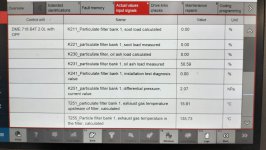
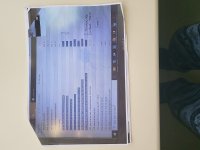
It mentions the measured readings quite alot in how it triggers a regeneration, if you have a look at a typical Porsche 718 2.0 and 2.5 GPF report you will see that on a vehicle that shows the K231 oil ash load measured at 100%, the following.

K211 Particulate filter bank 1 soot load calculated 0.00%
K221 Particulate filter bank 1 soot load measured 0.00%
K230 Particulate filter oil ash load calculated 0.00%

Enclose a GPF report showing the above details

You would expect that if the filter was blocked, the soot would build up to a high level which should put on the soot loaded warning light and message on the dashboard, it doesn't.

But our GPF reports always show no soot present and no significant pressure from the K251 differential pressure sensor reading.

How can our GPF software be working correctly if there are no values in these very important calculations.

Dave
 

Attachments

  • 20251112_100040.jpg
    20251112_100040.jpg
    2.8 MB · Views: 1
Hi Guys & Girls

Without prejudice

Following on from my last post, if you are told by a garage, or you have a code reader yourself, and you see the code P242F oil ash load exceeded.

This is what I suggest you do.

If your engine light comes on with a message, Engine control fault, Consult dealer Driving permitted on you the dashboard. Check for the code P242F oil ash load exceeded. Check this is the only code present concerning the GPF.

Book the car in with your local Porsche Dealer and ask them to check for DTC codes.
If they find the above code, ask them to show you the GPF data report.
This will show your oil ash reading K231 at 100%, it will also show your soot readings, K211 & K221 usually, they will show around 0.00%, or very low readings.

Check out your differential pressure current value reading K251, which will normally be very low, probably no higher than 6.0 hPa.

If your report shows these above values, ask your Dealer to contact Porsche and set up a case, under the heading of a manufacturing defect.

The reason this is a manufacturing defect is that the GPF soot loading warning mechanism is not working correctly, and the GPF filter can not be blocked because the differential pressure sensor reading is far too low.

What should happen is when the soot warning message comes on asking you to carry out a road regeneration it leaves two specific DTC codes in the ECU.

You can also remind them of the internal Porsche memo that was sent out to the Dealers in March of this year confirming a modified GPF filter that was fitted to these cars from December 2019 because of this DTC P242F.

We also have on file an email from Porsche Reading confirming on one of our cars that this fault was indeed a manufacturing defect and the case number confirming it.

Dave
 
Dave, thank you for your continued hard work on this. I am trying to get my head around what is actually going on here and also summarise where we are.

I saw a 2020 research paper published by the national library of medicine https://pmc.ncbi.nlm.nih.gov/articles/PMC7707118/

Most of this is way above my pay grade, but the conclusions include the paragraph;
As gasoline particulate filters gain a presence in the automotive sector, it is important that the variations in reactivity of the soot collected on the GPF are understood. This works leads to understandings that oil consumption and soot production rates provide key factors in determining soot reactivity as influenced by a relative ash to soot ratio. This understanding can aide in the development of engine controls that balance effectively thermal protection during active regeneration events and soot layer build-up for high filtration.

And from another site we het the essential distinction between ash and soot

What Is the Difference between Soot and Ash Accumulation in a DPF?​

Soot is the unburned carbon (particulate matter) that is trapped by the DPF and can be removed through the regeneration process (burned off). Ash, however, is the non-combustible residue from lubricating oil additives and metallic wear particles.
Ash cannot be removed by regeneration and gradually accumulates within the DPF, permanently reducing its capacity. Over the vehicle's lifespan, ash accumulation will eventually necessitate the cleaning or replacement of the DPF.

It seems that ash / soot ratios can vary according to many external factors, many of which we are aware of - e.g. oil consumption and type, operating cycles and parameters. Yet in our DPFs the soot / ash ratio is hard coded into the engine management which goes on to calculate the ash level. It seems that this calculation is wrong as when they say the ash load is 100%, the GPF is clearly not blocked. To make matters worse there is no possibility of re-setting a clearly erroneous measurement. That facility was not built into the original ECU. When the dealers have been forcing regenerations in affected cars, this is largely a waste of time as the ECU has been told that ash cannot be burned off, so will not reset.

However, I am sure it is not quite as simple as that, because when dealers have replaced the GPF, it does seem to have affected the ash load, albeit temporarily.
Let me test this logic on you. If, when the GPF is replaced, the old one had a 50% soot load, when it measures a 0% soot load in the new one, it will then reduce the ash load by 50% (i.e. to 50% from 100%) because of the fixed ash to soot ratio. However If, when the old GPF has had a regeneration and is empty of soot, there is no change when the new one is fitted, so the ash loading does not change and stays at 100%. This logic would explain why replaced GPF's quickly get back to over 50% ash loading and a small number of replaced GPF's still did not turn off the CEL.

If this logic is anything like correct, one way of fixing out of warranty cars would be to take the exhaust off when it has a high soot loading, clean the GPF independently and refit - basically fool the car into thinking it has had a new GPF.

Needless to say this is all supposition and speculation, but it does seem that, when GPF's were introduced, Porsche got the calculations wrong and have no way of putting it right.
 
Even I followed that summary, nicely written.

The last sentence I feel is spot-on, the factory do not have a fix or if they have the ecu can't be reset with the changes.
It is stonewalling the issue as there is no fix unless you have a new ECU to substitute rather than re-write some calculation.
Not sure how the tech side of all this got signed off way back, how a mod was introduced that seems to have no bearing on the root cause (revised DPF in 2019).

Head in the sand and hope the passage of time and the life of these cars ebbs away the problem.

Since the introduction of the water cooled cars there does seem to be a list of poor design or poor development and premature introduction of these 'new' designs.
 
Even I followed that summary, nicely written.

The last sentence I feel is spot-on, the factory do not have a fix or if they have the ecu can't be reset with the changes.
It is stonewalling the issue as there is no fix unless you have a new ECU to substitute rather than re-write some calculation.
Not sure how the tech side of all this got signed off way back, how a mod was introduced that seems to have no bearing on the root cause (revised DPF in 2019).

Head in the sand and hope the passage of time and the life of these cars ebbs away the problem.

Since the introduction of the water cooled cars there does seem to be a list of poor design or poor development and premature introduction of these 'new' designs.
You are spot on with this summary, although I think it is unfair to link it with the introduction of the modern water cooled models.
Porsche had lots of history with water-cooled engines (e.g. transaxle cars). Yes, some M96 flat sixes had problems but those were addressed in period and eliminated with the 9A1 engines. The GPF issue is to do with software and emissions, not the basic engine design. When the WLTP (Worldwide harmonised Light vehicle Test Procedure) was introduced for new vehicles, Porsche acknowledged they were having difficulty qualifying the new 911 model and delayed release to production for several months. The warnings were there.
For the 718, WLTP was a mid-life "fix" which probably saw less focus than getting the new 911 up to spec for production. Knowing that the ICE 718 line was being killed off, it was easy for Porsche to bury their heads in the sand with the 718 issues. No amount of pressure on Porsche now will change that since the model is out of production.
North America, their biggest market, does not require compliance with WLTP, so no worries of litigation being raised there. I assume these NA market 718s either do not have GPFs fitted or have different software.
The reality is that UK cars will work fine without the GPF. Also, current MOT testing does not test for WLTP compliance in the emissions, it is just the pesky malfunction indicator light (MIL) that is a problem.
Perhaps some clever person could come up with an aftermarket fix to ignore the ash error and simply illuminate the MIL when the differential pressure exceeds a specified limit. This might confuse PIWIS at a service or inspection and would invalidate any Porsche warranty, but if it means the car can be used as intended, who cares about these other things.
 

Posts made and opinions expressed are those of the individual forum members

Use of the Forum is subject to the Terms and Conditions

Disclaimer

The opinions expressed on this site are not necessarily those of the Club, who shall have no liability in respect of them or the accuracy of the content. The Club assumes no responsibility for any effects arising from errors or omissions.

Porsche Club Great Britain gives no warranties, guarantees or assurances and makes no representations or recommendations regarding any goods or services advertised on this site. It is the responsibility of visitors to satisfy themselves that goods and/or services supplied by any advertiser are bona fide and in no instance can the Porsche Club Great Britain be held responsible.

When responding to advertisements please ensure that you satisfy yourself of any applicable call charges on numbers not prefixed by usual "landline" STD Codes. Information can be obtained from the operator or the white pages. Before giving out ANY information regarding cars, or any other items for sale, please satisfy yourself that any potential purchaser is bona fide.

Directors of the Board of Porsche Club GB, Club Office Staff, Register Secretaries and Regional Organisers are often requested by Club members to provide information on matters connected with their cars and other matters referred to in the Club Rules. Such information, advice and assistance provided by such persons is given in good faith and is based on the personal experience and knowledge of the individual concerned.

Neither Porsche Club GB, nor any of the aforementioned, shall be under any liability in respect of any such information, advice or assistance given to members. Members are advised to consult qualified specialists for information, advice and assistance on matters connected with their cars at all times.

Back
Top