Dave, thank you for your continued hard work on this. I am trying to get my head around what is actually going on here and also summarise where we are.
I saw a 2020 research paper published by the national library of medicine
https://pmc.ncbi.nlm.nih.gov/articles/PMC7707118/
Most of this is way above my pay grade, but the conclusions include the paragraph;
As gasoline particulate filters gain a presence in the automotive sector, it is important that the variations in reactivity of the soot collected on the GPF are understood. This works leads to understandings that oil consumption and soot production rates provide key factors in determining soot reactivity as influenced by a relative ash to soot ratio. This understanding can aide in the development of engine controls that balance effectively thermal protection during active regeneration events and soot layer build-up for high filtration.
And from another site we het the essential distinction between ash and soot
What Is the Difference between Soot and Ash Accumulation in a DPF?
Soot is the unburned carbon (particulate matter) that is trapped by the DPF and can be removed through the regeneration process (burned off). Ash, however, is the non-combustible residue from lubricating oil additives and metallic wear particles.
Ash cannot be removed by regeneration and gradually accumulates within the DPF, permanently reducing its capacity. Over the vehicle's lifespan, ash accumulation will eventually necessitate the cleaning or replacement of the DPF.
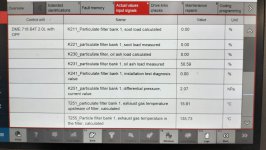
It seems that ash / soot ratios can vary according to many external factors, many of which we are aware of - e.g. oil consumption and type, operating cycles and parameters. Yet in our DPFs the soot / ash ratio is hard coded into the engine management which goes on to
calculate the ash level. It seems that this calculation is wrong as when they say the ash load is 100%, the GPF is clearly not blocked. To make matters worse there is no possibility of re-setting a clearly erroneous measurement. That facility was not built into the original ECU. When the dealers have been forcing regenerations in affected cars, this is largely a waste of time as the ECU has been told that ash cannot be burned off, so will not reset.
However, I am sure it is not quite as simple as that, because when dealers have replaced the GPF, it does seem to have affected the ash load, albeit temporarily.
Let me test this logic on you. If, when the GPF is replaced, the old one had a 50% soot load, when it measures a 0% soot load in the new one, it will then reduce the ash load by 50% (i.e. to 50% from 100%) because of the fixed ash to soot ratio. However If, when the old GPF has had a regeneration and is empty of soot, there is no change when the new one is fitted, so the ash loading does not change and stays at 100%. This logic would explain why replaced GPF's quickly get back to over 50% ash loading and a small number of replaced GPF's still did not turn off the CEL.
If this logic is anything like correct, one way of fixing out of warranty cars would be to take the exhaust off when it has a high soot loading, clean the GPF independently and refit - basically fool the car into thinking it has had a new GPF.
Needless to say this is all supposition and speculation, but it does seem that, when GPF's were introduced, Porsche got the calculations wrong and have no way of putting it right.