Menu toggle

Cayman 718 GPF Failure

Hi Guys & Girls

Without prejudice

Following on from my rant about the low differential pressure sensor readings we see on all these cars, when the filter is supposedly blocked.

When you look at the information contained in the internal memo, concerning the checks for possible causes of high ash load.
It clearly says, check the OPF differential pressure sensor for correct functionality ensuring the pipes to the pressure sensor are not blocked or restricted.

So let's talk about functionality.

Checking a differential pressure (DP) sensor for correct functionality involves verifying its electrical signals, testing its physical connections for leaks/blockages, and confirming its output changes appropriately with applied pressure.
Here is a step-by-step guide based on common diagnostic methods:

1. Initial Visual Inspection
  • Check Hoses: Inspect rubber hoses (if applicable) for brittleness, cracks, or soot clogging.
  • Physical Damage: Look for cracked plastic housings, melted insulation, or corrosion on connectors.
  • Wiring: Trace the wiring harness for chafing or damage.

2. Live Data Analysis (Diagnostic Scanner)
  • Connect a diagnostic scan tool (for automotive DPF sensors) and view live data.
  • With the engine off, the differential pressure reading should be at or near zero.
  • If the reading is high while the engine is off, the sensor or circuit is likely faulty.
  • Check for relevant fault codes (e.g., P2453, P2454, P2455).

3. Electrical Test (Multimeter)
Use a multimeter to check the sensor's power supply and signal voltage. Ensure the sensor receives the correct reference voltage (typically 5 volts) and that the signal voltage changes smoothly with pressure variations.

4. Pressure Test (Manometer/Vacuum Pump)
Verify hoses are clear of blockages and use a pressure pump to apply a known pressure. Check the scan tool data to confirm the pressure reading is accurate.

5. Zero-Point Check (Industrial/Transmitter)
For industrial transmitters, equalize pressure across both sides using a 3-way manifold and check that the output is exactly 4mA. A different reading may indicate drift and the need for calibration.

Summary of Fault Signs
Common signs of a faulty DP sensor include constant high or low readings, no response to pressure changes, or erratic data.

If you look at the no2 check, it says with ignition off the sensor should read zero, we have checked lots of these cars and everyone showed the running pressure when the engine wasn't running.

I firmly believe that these checking instructions from Porsche to their Dealers have not been carried out correctly, if they had been, the none existent back pressure would have been picked up, and the inaccurate sensor readings would definitely have been picked up.

 Dave
 
I have followed this topic for some time and I cannot recall if, of those who have paid for a new “filter” retained the “faulty” item. I’m aware that if repairs are done under warranty, the OPC retains the item.
I’d have loved to have kept my seized engine!
Regards
Bill
 
As I said a few posts back, if you pay for the £9000 filter then the old one is still yours, you have not part exchanged it!

That would allow you to have it examined, but at a cost (may not be that much).
Porsche will snatch back anything to do with this silly issue, so removing the chance to get more facts out of their control and strongly contest their action.
 
Hi 911Hillclimber

Without prejudice

Unfortunately these GPF filters are exchange, the new part number is 982254400FX, the FX denotes the exchange.

Retail cost of this part is £6,628.00 + vat, and the surcharge price is £757.00+ vat.

You don't need to check the exhaust, because there's nothing wrong with them, the only main fault they could have, is soot leakage, or an internal rattle, if the substrate is insecure, which you could see in the tailpipes.

All the photos I have seen on all the cars I have dealt with, had tailpipes with no soot present at all.

A light grey dusting with a hint of light brown, which is the ash.

This proves that these GPF filters are doing there job, turning the soot into Ash.

Ive said this before, just look at a 981 tailpipe and you will see what I mean.

On Pauls car last year an exchange GPF filter was fitted, which didn't fix the issue.

So a new GPF was fitted, and that didn't fix the ash % that had come back after the first GPF was fitted, as per the instructions on the internal memo, if the regeneration didn't reset the ash, fit a new modified filter.

And has we know, a new engine and turbocharger didn't fix it either.

One of our owners last year did over 10 thousand miles with his warning light and the code P242F coming on and off.

We monitored this car, and he sent me loads of photos of the GPF information along the way, the light off when the % dropped to around 90% ish.

Which proves 100% that these GPF filters are not blocked with ASH, because if they were, you would not be able to drive 10 thousand miles with a blocked exhaust.

This fault which was inherent from the point of manufacture, it was confirmed in detail in the internal memo sent from Porsche to their Dealers in March last year.

So therefore I believe the car is covered under the UK Consumer Rights Act of 2015. The Act states that if the fault is inherent from the start and can be proved to be so by the customer then they have rights under the Act.

We can prove that Porsche knew about this issue within the first year of production, they fitted modified filters to these vehicles post December 2019, this is all in the memo.

They just need to except responsibility for this fault on these cars and deal with it.


Dave
 
Thank you Dave, I had not picked-up the filter exchange unit requirement.
The action against Porsche for faulty parts rests with the car owner making a claim against Porsche.
Has anyone actually done this, I assume that is how Paul got so much done to fix the car by OPC/Porsche which failed so they had to buy the car back.
 
Hi 911Hillclimber

Without prejudice

We have another vehicle that had a new modified GPF fitted, last year, and unfortunately the ash came back, an AOS was then fitted, which made no difference to the ash level, after several regeneration attempts.

So the Dealer then removed the engine and stripped it down looking for signs of internal oil consumption, nothing was found just like Paul's car. The engine was refitted, and the car was returned to the customer, all this work was covered by Porsche.

The customer will be returning to the Dealer to have the Ash % checked again later in the year, just like all the other cars that have had the modified GPF,s fitted that we are aware of.

Again if the backpressure had been checked , none of these parts would have needed to be fitted, never mind all the time and inconvenience stripping the engine down.

We need to get our Dealers to do this backpressure check.

Dave
 
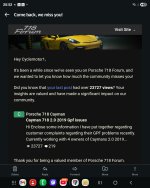
Hi Guys & Girls

I received an email today from the 718 Forum, saying they missed me, and on my last post to them they had 23,727 views.

Enclose a copy of the info sent to me, its brilliant that we are gaining this amount of interest on cause thats worth all our hard work.
Its a shame we are not getting the same interest back from Porsche to fix their customers cars.

My sign in is Cyclemotor1

Dave
 

Attachments

  • Screenshot_20260121_205217_Yahoo Mail.jpg
    Screenshot_20260121_205217_Yahoo Mail.jpg
    730.3 KB · Views: 21
Hi Guys & Girls

Are plan this year is to get more of these cars tested that display high ash values.

Iam looking to hook up with a local garage in my Harrogate area, just off the A1, where we can carry out detailed back pressure checks on these cars to support our challenge to Porsche Technical that these filters are definitely not the cause of this fault.

Anybody who would like this test carry out please contact me

Kind regards
Dave
 
Hi Guys & Girls

Without prejudice

Ive just sent this post to our colleagues at the 718 Forum.

When you really think about what has been happening, its absolutely ridiculously that Porsche and their Dealers are continuing to ignore the fact that these cars that we have been involved in, are fundamental wrong.

The soot load warning light is not coming on, even when the GPF is supposedly blocked with Ash, this is not right.

We had an owner with a 2.5 Cayman last year, where the Dealer told him he needed a new filter 9K. He contacted us, and we assured him the filter wasn't blocked, we told him to continue driving his car.

He covered over 10K, and we monitored its soot and ash levels along the way, the EML came on quite alot, but went out by driving using the deacceleration techniques mentioned in the drivers handbook.

Remember this instruction is to clear the soot in the GPF filter, not Ash, when the light comes on it refers to Ash loading.

He even managed to get his Mot done along the way.

This milege covered would be impossible if the GPF had been actual full of Ash.

The differential pressure sensor values on our cars are all over the place, thats not right.

Fitting these modified GPF filters, that are not fixing this issue, this is not right, we have documented proof to support this.

The fact that their internal memo confirms that this issue was present in the first year of production with the same DTC P242F, this is not right, and was not right.

You would expect that Porsche would support its customers in their time of need.

We have had to show them that the GPF information on the cars we have seen, is so obviously wrong, its ridiculous that they can ignore what we are seeing, this is definitely not right.

Sorry for repeating myself again, but if anyone with this issue is looking to the Club for help, they can see quickly where we are at this present time.

So we carry on
Dave
 
From all that has been said above it is possible to conclude that OPC's do not want to carry out the tests and diagnostic procedures that Porsche recommend. Neither Porsche GB, the OPC, or the customer will want to pay for the time and effort. Simplest solution to jump straight to where the value is, a new GPF at £9,000 and give the customer the choice - pay up or take the car away.

Those who do not wish to pay up have typically accepted the random CEL activation (it often comes and goes rather than stays on permanently) or, more likely, have moved the car on.

Porsche themselves seem to have concluded that 50% plus ash loads are acceptable as long as the CEL does not activate. There are likely to be many 718's in this state, but they are all running well. However we do expect some prevously repaired cars to 'light up' in the near future. We just need a few owners to stick with their cars to see it through to the next phase. This will involve independent checks / tests and a tussle with Porsche to get proper recognistion of this problem and a final solution. Dave and the club are up for that, but we do need a couple of cars.
 
Hi Guys

Without prejudice

Another busy week, trying to get are Dealers to except that without high differential senser pressure readings, and excessive soot being present on our cars, these filters cannot be physically blocked with ash.

If you Google this question below, you get this response, unfortunately because I have been researching this subject for quite a while, the response comes back quite quickly, and sometimes slightly different in information.

But it makes alot of sense, my search question below.

How can ash be recored present in a GPF filter, when its not actually there, and no soot readings are found, along with no significant differential pressure sensor readings.


A recorded presence of ash in a Gasoline Particulate Filter (GPF) when none actually exists, combined with low differential pressure and zero soot, is almost always the result of a calculated software value rather than a physical measurement. The ECU uses models, not real-time sensors, to estimate ash accumulation.

Here is how a "false" ash reading can appear in your diagnostic tool:
Algorithm-Based Calculation (Not Physical Measurement): The ECU does not have a sensor that directly "sees" ash. It calculates ash buildup based on fuel consumption, mileage, and number of regeneration cycles. If the engine has high oil consumption or if the counter was never reset after a previous service, the software will show a high ash percentage.

Missing Service Reset:
If a new GPF was installed but the technician did not perform a "GPF/DPF Reset" or "Initialize Learning Values" in the software, the ECU still believes the old, plugged filter is installed.

"Virtual" Ash from Short Trips: Some systems count "pseudo-ash" or increment the ash counter during frequent short trips where the filter never gets hot enough to clean, incorrectly increasing the calculated value.

Radio-Frequency (RF) Sensor Error: Modern systems sometimes use an RF sensor to detect ash, which measures dielectric properties. If the sensor is faulty or incorrectly calibrated, it can falsely report high ash levels.

Our cars do not have a radio- frequency sensor fitted.

Why No Differential Pressure (DP) or Soot?
Ash is not Soot:
Ash is non-combustible residue (from oil additives), while soot is carbon.

Low Ash Density:
Unlike soot, low-to-moderate levels of ash often do not create a significant pressure drop across the filter, explaining why your sensor shows nothing.

Zero Soot:
You have no soot because the car recently completed a successful regeneration (burning off carbon) or it has not been driven enough to accumulate any, leaving only the "calculated" ash behind.

Conclusion: The issue is likely a need to reset the GPF learned values via diagnostic software.

The problem on our cars, is we can not reset the learned values on the sensor or the GPF, so when we fit a new sensor or GPF, the algorithm is very confused, because it needs this zero calibration, a base line starting point.

Its just unfortunate our Dealers and Porsche Technical don't agree with us.

Dave
 
Dave, John - I think you have run the course with the negative response form Porsche.

Perhaps its now time to get the media involved before anyone else is taken to the cleaners for £9k.
 
I don't know, but guess that this issue is now common knowledge in the '2019 Cayman' 4 pot community.
It will also be on the check list for a potential buyer of these great looking and fast cars.

Going public risks the whole of the 718 generation car being tared with the same brush, bit like RMS/bearing issues on 986/996 etc which a small number of cars suffer from, but is a real worry for a buyer (as it was for me looking at a 996 and ended up buying a Gen2 987.2 Boxster instead).

I would think contacting the Trading Standards people a good first move, but going public will hurt the OPC much more and mybe open thier minds, but i thing they are under 'orders' to ignore things from the factory.

Who know, but it does feel like the wall of silence needs a different approach. The owners have to stand up?
 
Hi Dale

Without prejudice

Yes the majority of our cars have been 2019, built at the Stuttgart- Zuffenhausen plant, but we have seen some issues on later cars but not of the same volume, thankfully.

We are still getting reports from our owners that the Dealers are still trying to charge for replacing the GPF filters, using the excuse that the car hasn't got full Porsche Service history.

When you read the information on the Porsche memo sent to the Dealers in March last year its very interesting.

The internal memo also details important checks to be carried out regarding high ash loads found on their vehicles.

This is the paragraph regarding the instructions, Ive added this so that none members can see what was written below.

Several causes of the high ash load have been found across various vehicles therefore to prevent repeat issues it is important to check all possible causes of high ash load before proceeding with any repair.
These include completing cylinder leakage checks to ensure oil is not entering the cylinder, checks of the intake and exhaust for signs of excessive build up which could be a result of a leak from the oil separators, turbocharger or valve stem seals.It is also important to check the operation of the turbocharger actuator to ensure this is functioning correctly and check the OPF differential pressure sensor for correct functionality ensuring the pipes to the diferential pressure sensor are not blocked or restricted.

So these instructions have not been carried out correctly, if the differential pressure sensor pipes have been checked for restriction, or blockage, then surely the next check would be a back pressure check to confirm the sensor reading accuracy.

These pipes are already disconnected so connecting a manometer to the supple pressure pipe to measure the actual back pressure of the GPF would have been easy.

At this point they would have found no back pressure present to support an algorithm ASH calculation of the 100% recorded.

So if back pressure was non existent then it total dismisses the next instruction on the memo which was written below.

The service history of the vehicle sould be checked and its confirmed that the correct low Ash oil has been used on all services.

We then move on to the last paragraph below.

If no causes can be located and all the above checks are all confirmed as OK, then in some cases the OPF can be recovered therefore a OPF regeneration should be attempted to see if the OPF ash load is able to reset.
If this has already been attempted or the ash load level doesn't not reset when the OPF regeneration is attempted then the OPF should be replaced, and the vehicle retested.
The new OPF's (982254400AF) have been modified to prevent this issue. All vehicles with a production date later than December 2019 should already have the modified OPF a d are therefore not relevant to this document.If there are any issues outside of this model year range please submit a PRMS ticket to Porsche.

So there you have it, they have been aware of this issue for a long time, they built these vehicles without the facility to adapt (zero) the differential pressure sensor and the OPF after replacement or durring service. If this is not carried out the algorithm that calculates the Ash cannot function correctly.

Instead they have had to carry out soot regenerations in an attempt to clear ash from the OPF, that wasn't there, to try and reset the algorithm to zero.

They also didn't carry out the instructions to test the new OPF when it was fitted, for Ash coming back on the earlier cars.

When we got involved with the 13 cars that had the new GPF,s fitted at Porsche,s expense we made sure they returned to the Dealers and the ash level check was carried out.

What we have found is the Ash comes back at an unacceptable level, which can not be explained by the Dealers, they just say Porsche says its ok.

All we did, was to look at the GPF data to see that on every car without exception the differential senser reading made no sense at all, and the lack of soot present on a supposedly blocked GPF definitely made no sense at all.

If the GPF was blocked, where was the soot going and why was the car driving perfectly, even with the EML light on.

So how can Porsche and their Dealers still insist that this fault is caused by the customer using the wrong engine oil and doing short journeys.

This is a manufacturing defect, that was built into these cars right from the beginning, they have confirmed this in the internal memo.

Its about time they started to help their customers with this fault, because this has been a major miss-diagnosis right from the start.

A simple back pressure check carried out would have pointed Porsche Technical into a different direction in trying to fix this issue, and the algorithm would have been a good place to start.

How many of these working GPF filters removed and sent back to Porsche is it going to take for the penny to drop.

Its no wonder they are an exchange part with a £775.00 + vat surcharge cost.

Dave
 
Sorry everybody

Without prejudice

It always happens to me when I send out a post, I forget an important fact that should have been on the last post.

So here it is.

We must not forget Paul,s GPF journey last year and the battle he had trying to get Porsche to fix his 2019 2.5 Boxster GTS with this Ash issue.

He had a exchange GPF fitted that didn't fix the ash issue, he then had a brand new GPF fitted and that didn't fix the car.

They carried road tests and PWIS checks on these new filters and they realised the GPF wasn't the issue.

They then removed his engine, stripped it down looking for internal oil consumption issues, none found. Road tested again, no change in the ash reading.

If you remember this was the instruction in the internal memo.

They then went on to fit a brand new exchange engine that made no difference to his current high ash level, and then they fitted a new turbo, which again didn't make any difference to his ash reading.

So between Porsche and his Dealer they gave him his money back, because they couldn't fix his car.

This is why we are 100% certain its a software issue, not an exhaust issue.

Dave
 

Posts made and opinions expressed are those of the individual forum members

Use of the Forum is subject to the Terms and Conditions

Disclaimer

The opinions expressed on this site are not necessarily those of the Club, who shall have no liability in respect of them or the accuracy of the content. The Club assumes no responsibility for any effects arising from errors or omissions.

Porsche Club Great Britain gives no warranties, guarantees or assurances and makes no representations or recommendations regarding any goods or services advertised on this site. It is the responsibility of visitors to satisfy themselves that goods and/or services supplied by any advertiser are bona fide and in no instance can the Porsche Club Great Britain be held responsible.

When responding to advertisements please ensure that you satisfy yourself of any applicable call charges on numbers not prefixed by usual "landline" STD Codes. Information can be obtained from the operator or the white pages. Before giving out ANY information regarding cars, or any other items for sale, please satisfy yourself that any potential purchaser is bona fide.

Directors of the Board of Porsche Club GB, Club Office Staff, Register Secretaries and Regional Organisers are often requested by Club members to provide information on matters connected with their cars and other matters referred to in the Club Rules. Such information, advice and assistance provided by such persons is given in good faith and is based on the personal experience and knowledge of the individual concerned.

Neither Porsche Club GB, nor any of the aforementioned, shall be under any liability in respect of any such information, advice or assistance given to members. Members are advised to consult qualified specialists for information, advice and assistance on matters connected with their cars at all times.

Back
Top