Hi, its me again,
Without Prejudice
Following on from our discussions regarding the soot particulate warning light that is not working on the the cars we have been involved with.
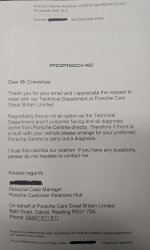
Porsche Technical have always been sure that this warning light should come on if the GPF filter is clogged with soot.
Enclose a written response from Porsche Customer Care confirming this, on a vehicle that recently had a new GPF filter replaced free of charge.
This was due to a manufacturing defect confirmed by Porsche Technical, because the trouble code P242F was present.
On all the vehicles that had an oil / ash reading of 100%, Porsche Technical advised the dealers to replace the GPF.
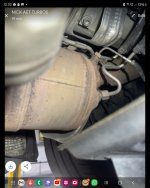
I have managed to see the GPF exhaust data, which was suppled by our drivers,
and in all cases they had a very low differential pressure sensor reading.
In fact the highest reading out of 12 cars was 5.64 hPa.
Sorry for repeating myself again but when a filter is blocked, you would always get higher readings than this.
Bearing in mind the differential pressure sensor would normally signal the ECU to start the regeneration process, put on the warning light, and assist in heating the exhaust to burn off the soot.
So if these GPF filters are blocked with ash at such low mileages, why is this happening.
Could it be that incomplete regenerations by the vehicle without the engine management assisting, during low temperature driving is causing the premature ash build up.
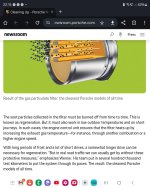
This may explain the situation we are in, after all many studies have been carried out regarding ash behaviour in GPF filters. We know what the affect of using the wrong engine oil can do.
It's quite a complex issue, and it's ongoing.
And we must not forget the role the AOS can play in contaminating the GPF with excessive oil droplets.
Back to the light not coming on, a simple check would be to increase the pressure on the differential pressure sensor with a mityvac tool.
These sensors generally run between 0 and 100 kpa, at idle, which is 15 psi.
The mityvac tool has a max pressure of 30 psi, this range should be enough to put on a warning light, or a trigger a diagnostic trouble code.
The only issue that we have had recently on some of the vehicles that have had replacement GPF filters fitted, is
the dealers found it difficult to reset the oil ash % level back to zero.
So if we could get the dashboard soot warning light working.
Check for exhaust back pressure, to confirm that we need to replace the GPF.
Check the function of the differential pressure sensor and its affect on the upstream temperature reading T251.
Find a quicker way of re setting the oil / ash reading %.
Start checking the AOS vacuum readings on these cars with a manometer to stop oil contamination hitting the GPF.
Then hopefully things should be alot better.
Sorry for going on again
Dave