Menu toggle

Cayman 718 GPF Failure

Hi John,

I would agree with you but it doesn’t explain that after replacing everything in my car except the brake pads, it still was showing a 33% ash fill with a new reconditioned engine from Porsche Germany and brand new turbo and new exhaust.

Software algorithms and controls around this measuring process need to be looked into, but we all know that it’s highly unlikely this will get pursued.I have discussed with Porsche and mentioned to Dave that it could be that the calculation is just out by a factor of x 10 but that doesn’t explain the random number jumps we are seeing when new parts are fitted.

As Dave has mentioned previously unlike other manufactures Porsche doesn’t have a soft rest function and just relies on a forced regen.

As a note for owners if the OPC completes a forced regen on your car as part of there process they are supposed to change your oil and filter due to the extremity of the heat cycle put through your engine.

Outside of the Porsche warranty world, companies are offering their services to owners and are tuning the issue out.. this evidence is clear all over the 718 forum.
 
Last edited:
Just a thought, but has anyone looked at the DME in terms of software version (problematic and later versions) Usually if there is a software change the Version will have been changed. Alternatively the file size may be different…assuming someone smart can get into it…
 
I saw that, but what version software was loaded on the DME ? If the dealer loads the software via a link to the factory (as bmw do) by chassis no without checking the Version it might be the same again.

It seems the conclusion on the thread is its a software issue. If later cars are ok and the Gpf is the same part no…then Porsche must have revised the software surely.
 
Hi Guys & Girls

Without prejudice

Sorry its been awhile, not posting, we have quite a few cars going back into Dealers for oil ash % checks after the modified filters have been fitted.

Will update you has they come in, but the reality is the oil ash comes back very quickly on these new modified filters that have been fitted.

The Dealers are still insisting that the oil ash % is real and the GPF is blocked, they replace them and it comes back, not at 100%, but usual around 50% on average.

The light is out, so thats good thing.

Its quite incredible that the Ash can disappear after a soot regeneration is carried out, and then it comes back after a few hundred miles.

Where does it go, and how does it come back in to the new filter after such a short time.

Hopefully one day Porsche Technical will explain to us why this is happening.

Thankfully I haven't had any calls recently from owners that have been told by their Dealer they need a new GPF.

Maybe the information we are posting is getting back to Porsche Technical.

We are still researching the software, will update you all when we get some software evidence.

Our views are at now at a staggering 78%, so thankyou all for you views, lets keep pushing on.

Regards

Dave
 
Just speculation Dave - I wonder if the OPC's are doing a software update when fitting new GPF's? I guess not, if they still cannot sort cars like Paul's, but it does seem strange that the levels settle at around 50%. Is this the level we would find on a normal / healthy car (i.e. one that is running without problems or CEL showing)?
 
Hi John

Without prejudice

Its always been a shame that Porsche Technical have not engaged with the club on this topic.

I have a data base on all the cars we have dealt with over the last 2 years, detailing the GPF data, mileage covered, and the full history of the repairs carried out.

Its not good reading, it clearly shows after all the work that was approved by Porsche Technical and Warranty on all our faulty cars, has proved to be a major miss diagnosis BLUNDER.

We have known this ever since we had sight of the first GPF report on Mark's car, it clearly showed no back pressure recorded on a GPF filter supposedly blocked according to Porsche.

From the start it was a battle to overturn Porsche Technical and the Warranty Departments desision, that the owners had to pay.

But thankfully we managed to get these GPF reports, and it all started to make some sense.

Paul's car is the final straw, it confirmed that whoever was making the decisions to replace all those parts, was either desperate, or was trying to avoid the SOFTWARE possibility.

Well, the only thing it can be is the software, so Porsche Technical need to sort this out, all the hard work has been done regarding replacement of engine and emission related parts.

We now can monitor these cars using inexpensive diagnostic testers, that you can purchase on the Internet, check out previous post.

None of our cars had high mileages, so you wouldn't expect to see high ASH values on the report, it might help if the algorithm was changed to show an ASH value in the calculated section K230, which always reads 0.00%, for some reason ?.

And the most over looked reading has always been the K251 differential pressure sensor reading, which has never shown an high enough reading of back pressure to confirm a blocked GPF.

It would also be great to see the soot regeneration message working on our cars, has detailed in the drivers manual.

I recently looked at another GPF report on a Cayman 718 GT4, the information provided, especially exhaust temperatures that are created from actual exhaust temperature sensors fitted to the exhaust, shows a more detailed and comprehensive report.

Why are our cars so different, could this be the issue, surley software receiving actual data thats correct, must be better, and it seems to be, has we are not seeing GPF issues on these cars.

I think going forward, has Paul said, a few posts back, we need to introduce a GPF condition check, to be carried out on these cars.

These can be done by the Dealers, Porsche Independents or anyone selling GPF cars.

It should be part of the Service Schedule,
and the Pre sales inspections, bearing in mind its importance regarding emmisions, and the issues we have been having.

Even EV vehicles now, are having Battery condition checks carried out in order to protect consumers when they are considering buying a second hand EV.

Sorry John, I've gone on a bit

Dave
 
Hi Guys & Girls

Without Prejudice

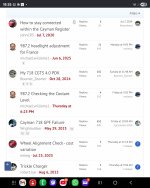
Just checked our views, we currently have 80K views on our 718 GPF campaign, this is brilliant.

On September the 6th last year we only had 14K.

I know views dont get us any prizes, but what it does show is the interest shown regarding our campaign, lets push on to 100 views +.

We still have all our cars out there with new modified filters fitted, that are still faulty, and the Dealers hopefully will be pushing Porsche Technical for some answers.

Will update you has soon as we have some information.

Thanks again to all the people who are clicking on to forum, it will hopefully help in the long run.

Enclose a copy of the forum view page

Regards
Dave
 

Attachments

  • Screenshot_20250813_192554_Chrome.jpg
    Screenshot_20250813_192554_Chrome.jpg
    634.9 KB · Views: 8
What happens when repaired cars have a DPF failure again and return to the OPC with the same issue asking for a resolution to get back on the road?

I presume these removed DPF units are sent back to the manufacturer vis Porsche for Porsche to claim against them.

The manufacturer will resist this if they find NFF and ask for Porsche to explain the situation.

This must now be happening?
 
Hi 911hillclimber,

Without Prejudice

We are still waiting for responses from Porsche Dealers regarding all the vehicles that have gone back for the oil ash % check after a new modified filter as been fitted, and unfortunately the oil ash % figures are already at an unexpectable level, will update you all when we get some news.

Have a look again at all the work that was carried out on Pauls car, page 32, July 23rd, detailed on this forum, it doesn't make good reading, but does confirm Porsches attempts to try and solve this issue.

Regarding the return of the GPF filters, you would definitely expect that the manufacture would not be happy if these units were sent back to them as faulty, especially Pauls recent GPFs.

I would like to ask Porsche Reading, what happens when a 718 is sold out of the Porsche network, and the DTC code P242F is present.

I have had quite a few phone calls from new owners, with these cars, where the light has come on shortly after purchase.

We need to introduce a standard GPF condition check to be carried out, showing oil ash levels, whenever these cars are sold. This would protect new owners of these cars, and the data from these checks could be sent to Porsche Reading for analysis.

With all our Porsche Dealer sold vehicles with his fault, the journey to get Porsche to admit liability hasn't been easy, but we got there eventually, but dealing with independent garages is not has straight forward.

In fact its been terrible, the usual reply from the selling dealer, is get your vehicle diagnosed, speak to your warranty company, and no the GPF is not covered.

Your on your own.

Also another disturbing trend, is that we are seeing many reports where these cars are being fitted with different exhausts and the GPF is programmed out, to remove this fault from the car. This is because the cost to replace a GPF filter, THATS not faulty, has been the only current option available from the Dealers, hopefully this should stop now.

Its illegal to remove a GPF, unless its for track use only, if you look at the tail pipes on a 718, you will not see any soot at all, check out a 981, and see the difference.

It seems very simple to me that after 2 years of dealing with Porsche Dealers and Porsche we have a situation that Dealer sold cars, have had worked carried out on these cars covered by the manufacturer.

In August 2024 we had conformation in writing from the Porsche Customer Relations Hub in Reading, that the GPF filter fault on one of our cars was identified by the Technical and Warranty Teams to a Manufacturing Defect.

Sadly the owner of this car has recently sold it due the the oil ash level coming back.

In March this year we had further conformation in writing by way of an internal memo to the Dealers explaining what to do if the DTC P242F, (oil ash load to high) presents itself.

This memo clearly explains what the Service departments need to do regarding the possible causes of engine oil getting in to the cylinders, and causing the formation of Ash particles.

On the 2 vehicles that have had the engines removed, stripped down to try and find signs of engine oil getting into places it shouldn't, nothing was found, confirming the engines were not the issue.

Various detailed checks had to be carried out, then if no oil was found to be present, a GPF regeneration had then to be carried out.

This was to see if the GPF ash load would reset, if it didn't re set, the GPF should be replaced and re tested.

Again no mention of a simple back pressure check to be carried out.

We have proven beyond any doubt on our cars, that have had new filters fitted, the filter is not the issue.

The memo went on to say, a new GPF (982254400AF) had been modified to prevent this issue. All vehicles with a production date later than December 2019 should already have the modified GPF fitted, and are not relevant to the document. If there are any issues outside of this model year range, please contact Porsche.

It seems to me with all this information we have above, that Porsche Dealers need to support our independent garages, and new owners, if a vehicle has this GPF issue, there should be a procedure to follow which should be implemented to at least record these faulty cars, and give reassurance to new purchasing owners, that they will not be cast adrift.

At that moment if you own a 718 4.0 GTS, or a GT4, you are in a very good place, we need to fix our cars and put them back in a good place.

There is nothing on the road that equals the driving experience of the 718 2.0 and 2.5 cars, we need these entry level cars, not every one likes 911s.

Any feedback would be appreciated, we are on 81K views at the moment, thankyou all for your interest, and support.

Dave
 
Thank you for the post Dave, it will help many readers who are technically interested and/or an owner or indeed a potential owner.

Seems the actual filter is ok, it is clear it functions and new/modified ones are just as 'bad' as the originals then the fault is elsewhere, and can only be the program that ascertains the condition of the filter at a given time. This calculation is wrong in the car's system so there needs to be a change and that revision installed in the car's electronics somewhere.
I hope my summary is right.
Overall, I see this as a head-in-the-sand position from Porsche, starting with the Factory and sort of cascading down to the dealers who seem to be in a straight jacket.
When I worked, (in design/manufacturing) we would contest every return where there was a question mark raised by our QA dept, we would not simply pay unless the part had obviously failed. This forced the company returning the parts to justify the return.
Surely Porsche must now be getting considerable resistance from the filter manufacturer, and so considering what is the true issue by now?

Really good factual professional thread, and I am sure all will be corrected, but in what time scale.
These cars are going to get 'black-listed' due to this fault getting out into the public domain. (ie IMS bearings etc)

A very expensive problem to own.

I'm not helping much here, but feel very disappointed that Porsche are acting this way, but I'm assuming they have a fix!
 
Hi 911Hillclimber

Without prejudice

Thanks for your feedback, your summary is spot on, Porsche are the only ones that officially can change the emision software on these vehicles.

I have seen software thats been changed, on our cars, and you can see its different, when its changed the oil ash reading goes from a normal 0.00 % reading to a 0 (zero).

This shows the GPF oil ash function has been taken out of the system.

This can not be allowed to happen on an emission controlled vehicle, and if Porsche do eventually change the software, they could refuse to do so on a car thats had its software changed in this way.

What should happen is the parameters that calculate this oil ash percentage need to be adjusted, not removed completely.

From what I have read on the Internet regarding vehicle emissions, if any vehicle manufacturer that has more than 25 vehicles, same model, that have emission control problems reported, they have to report it to the emission people that approved the emissions system before the vehicles were allowed to be sold.

This is why only the Manufacturer can change the emission control functions on their cars, if they need to be changed.

Dave
 
Hi Dave

Why do you think Porsche are reluctant to update the software? This could be done when the cars go in for service, the GPF reading could be checked and a software update implemented, this would put owners minds at ease instead of them going through the worry of a 9K bill and ultimately them getting rid of their cars!

Keep up the good work!

Regards

Mark
 
Hi Mark, and Greenman986s

Without prejudice

Thanks for your posts guys, good feedback is always appreciated.

When think Mark how far we have come since you first posted out about your GPF.

Page 1, May 29th 2023, its taken along time, but have achieved alot.

We have managed to overturn Porsches desision to charge our members for replacing an expensive GPF filter they didnt need.

Sadly we couldn't help everyone with this issue.

We have proved along the way, when looking at the GPF data on these vehicles the data makes no sense at all.

We have struggled in most cases to get this info, but its proved that we were right from the beginning, no back pressure, no blocked exhaust.

The sad thing is we were told that the wrong engine oil, or driving style caused this issue, and it seemed the Dealers believed this was the case, they should be embarrassed.

Just think of all those customers stood at a Porsche reception desk trying to comprehend the news given, that they needed 8K to fix a car that was running ok.

No performance issues, no fuel economy etc, and at that time, no help from Porsche.

We were also told that the Porsche Extended Warranty wouldn't cover the replacement of the GPF, even though it wasn't listed in the exclusion section of the Warranty, funny it is now.

But the worst thing is the Major Miss Diagnosis of this fault, which we can prove 100%, due to all these modified filters that have been replaced, and its still an issue.

We set out over 2 years ago on a quest to help our owners and Porsche and the Dealers with this issue, and todate we have had no response at all.

Shocking, unbelievable you might say, we expect better from Porsche, these are expensive vehicles afterall.

But one thing for sure, we are going to save the reputation of the 718 GPF fitted cars, with or without Porsches help.

We have other avenues to go down, more research to do, please keep checking our forum.

Regards
Dave
 
Hi Guys & Girls

Without prejudice

Hi,
Just had some amazing news last night from our friends on the 718 Forum.

I posted a copy of my July 24th post to them, and it attracted over 19,810 views.


This is amazing, but when will we have a resolution.

Regards
Dave
 
Hi Guys & Girls

Without Prejudice

Good morning

Last night I put a search text on Google has follows, VCDS GPF OIL ASH RESET VALUES.

VCDS (VAG-COM DIAGNOSTIC SYSTEM), is an aftermarket diagnostic and programming tool used for Volkswagen, Audi, and Skoda vehicles, its been out for year's.

This is what came back, a detailed diagnostic path on how to reset the oil ash values on GPF and DPF vehicles, enclose below.

To reset the oil ash value for a Gasoline Particulate Filter (GPF) or Diesel Particulate Filter (DPF) using VCDS, you typically perform an engine adaptation by entering Security Access and navigating to the Adaptation (10) function. After selecting a relevant channel like "Carbon Mass (DPF Replacement)" or "Particle filter initialization" (often associated with the IDE00275 or IDE07903 ID), you save a new value, often 1, which the system may then change to 0. This process is necessary after cleaning or replacing the GPF to ensure the ECU accurately reflects the filter's new state.

Step-by-Step Reset Process
1. Prerequisites:
Ensure the ignition is on, but the engine is off.

2. Access Engine Adaptation:
In VCDS, select the Engine controller.
Perform Security Access (16) by entering the required code shown in the VCDS pop-up balloon for "Adaptation Enabling".
Proceed to the Adaptation (10) function.

3. Select Adaptation Channel:
From the dropdown menu, find the appropriate channel, such as "Carbon Mass (DPF Replacement)" or "Particle filter initialization". You may also look for the code IDE07903 if the descriptive name isn't available.

4. Save New Value:
Save a new value of 1 to reset the learned carbon/ash mass.
The system may automatically change this value to 0 after a successful reset.

5. Verify and Clear Codes:
Check for and clear any fault codes that are present to confirm the process was successful.

Important Considerations
GPF vs. DPF:
The process is similar for both types of filters, as the principle is to recalibrate the ECU's calculated values after a physical intervention on the filter.

After Cleaning/Replacement:
This adaptation is essential to perform after the GPF has been cleaned or replaced to ensure the system knows the filter's current, accurate condition.
Calculated Value:

The ash load is a calculated value, and resetting it ensures the ECU's calculations are based on the new, reset state of the filter.

Looks straightforward, obviously the differential pressure sensor readings would have been checked to confirm no back pressure was present.

Now, when we look at the way it seems to be done at a Porsche Dealer, the oil ash % is re set by attempting a regeneration, even though there is never any back pressure recorded by the differential pressure sensor.

The recent internal Porsche memo, confirms this procedure, as follows.

In some cases the OPF (GPF), can be recovered, therefore a OPF regeneration should be attempted to see if the OPF ash load is able to be reset. If this has already been attempted or the ash load level doesn't reset when the OPF regeneration is attempted then the OPF should be replaced and retested. The new OPF`s (982254400AF) have been modified to prevent this issue.

Porsche`s words not mine.

We also know on Paul's car, when the new modified GPF filters were fitted, and a regeneration was carried out, the oil ash % figures came back.

Could it possibly be that the PWIS system that the Dealers use to diagnosis, and program these cars doesn't have the capability to carry out the reset process required.

If you read through the above VCDS procedure, a REGENERATION of the GPF, or DPF is not mentioned ?.

We have also heard from Dealer technicians that when a differential pressure sensor is replaced on these cars, they cannot carry out a adaptation on that sensor, its plug and play.

The adaptation removes old data from the ECU which is vital for the sensor to function correctly.

We have been pushing to look at the software for quite a while now, after lots of filters have been fitted, and we still have the problem.

This confirms the fault is not the filters, the filters we have dealt with, haven't been blocked with ash.

Maybe its a combination of Diagnostic and software thats stopping this simple oil ash reset to be carried out.

Sorry for going on

Dave
 
For a while now I've been convinced the filter itself is good, it is the software and it's assessment that is wrong, inaccurate or just not fit for the purpose.

Only Porsche Germany can resolve this imho.
This will only happen if this topic is kept alive with straight facts as you have so skilfully done.

Keep at them!
 
Whilst this is just speculation on my part, I am convinced that Porsche know what the problem is and how to fix it. However, the software and other control parameters in the car are part of the specification that was holologated for productions (TUV etc). To change these would be a 'big deal' and would likely involve lots of other settings and potential issues - the knock on effect - which may affect much bigger numbers and be very costly.

One approach to this, which would result in what have experienced so far, is to say nothing and deal with each case on a one by one basis. If there is no common issue to be addressed, then there is nothing to be done about it. This is a strategy that has worked before and ultimately, as cars do get fixed in one way or another, the noise dies down and it all goes away at the cost of a few unhappy punters.

We will try to keep this alive, and any suggestions as to how this may be achieved would be welcome. But ultimately we may have to be happy that Dave's work has prevented members and owners from getting ripped off financially by the OPC network.
 
Whilst this is just speculation on my part, I am convinced that Porsche know what the problem is and how to fix it. However, the software and other control parameters in the car are part of the specification that was holologated for productions (TUV etc). To change these would be a 'big deal' and would likely involve lots of other settings and potential issues - the knock on effect - which may affect much bigger numbers and be very costly.
dieselgate...
 

Posts made and opinions expressed are those of the individual forum members

Use of the Forum is subject to the Terms and Conditions

Disclaimer

The opinions expressed on this site are not necessarily those of the Club, who shall have no liability in respect of them or the accuracy of the content. The Club assumes no responsibility for any effects arising from errors or omissions.

Porsche Club Great Britain gives no warranties, guarantees or assurances and makes no representations or recommendations regarding any goods or services advertised on this site. It is the responsibility of visitors to satisfy themselves that goods and/or services supplied by any advertiser are bona fide and in no instance can the Porsche Club Great Britain be held responsible.

When responding to advertisements please ensure that you satisfy yourself of any applicable call charges on numbers not prefixed by usual "landline" STD Codes. Information can be obtained from the operator or the white pages. Before giving out ANY information regarding cars, or any other items for sale, please satisfy yourself that any potential purchaser is bona fide.

Directors of the Board of Porsche Club GB, Club Office Staff, Register Secretaries and Regional Organisers are often requested by Club members to provide information on matters connected with their cars and other matters referred to in the Club Rules. Such information, advice and assistance provided by such persons is given in good faith and is based on the personal experience and knowledge of the individual concerned.

Neither Porsche Club GB, nor any of the aforementioned, shall be under any liability in respect of any such information, advice or assistance given to members. Members are advised to consult qualified specialists for information, advice and assistance on matters connected with their cars at all times.

Back
Top